Berlin Communism and Berlin Wall Walking Tour
Meet your guide in the afternoon at Berlin’s Brandenburg Gate. Proceed with your guide into the former East German sector of Berlin, learning about daily life and key events during this critical Cold War period. Follow the path of the iconic Berlin Wall which once split the now-reunited German capital in half, learning about the people, places, and secrets that fueled the battle between East and West during the period following World War II. Over the course of your visit, get a look at key East Berlin sites from the Soviet period including the one-time embassies of the major Cold War powers, key Berlin Wall crossing spots such as the “Palace of Tears" that once separated the two divided cities. As you explore, your guide also shares stories about the key events and moments of Cold War Berlin. Learn about the Stasi, East Germany’s secret police, hear about dramatic escape stories, and discover the meaning behind the concept of “ostalgie” in modern-day Berlin. For a more detailed run-down of key trip highlights, please review the itinerary details below.
Highlights
- ✓Learn about East Berlin form an English-speaking guide
- ✓Get your steps in with a walking tour
- ✓Hear about daring escape attempts from East Berlin and the notorious Stasi secret police
- ✓A great introduction to the Cold War history of Berlin
What you'll see & do
- ✓Meet your guide at the Brandenburg Gate, the neoclassical landmark that became the defining symbol of a divided — and finally reunited — Berlin. There is no better place to begin the story of the Cold War city. Your guide sets the scene at the end of the Second World War, when a defeated Germany was carved into four Allied occupation zones. Berlin, though it lay deep inside the Soviet zone, was itself split four ways — and in 1949 the country divided into the communist GDR in the east and the democratic FRG in the west, with this city on the frontline between them. For nearly three decades the Gate stood marooned in the Death Strip, unreachable behind the Wall. Your guide introduces the walk ahead: a journey through espionage, surveillance, divided families and the courage that finally brought the Wall down.
- ✓We stop before the grand Russian Embassy on Unter den Linden, a vast and imposing building that speaks of Moscow's power at the very heart of the city. Your guide uses it to tell the story of Soviet control. After the Red Army took Berlin in 1945, Soviet occupation policy reshaped the east, and in 1949 the German Democratic Republic was born, governed by the all-powerful Socialist Unity Party (SED). Yet real authority lay in Moscow — as became brutally clear in June 1953, when Soviet tanks crushed a workers' uprising in the streets of East Berlin. Your guide explains how the Brezhnev Doctrine later formalised Moscow's grip over the entire Eastern Bloc. On paper the GDR was a sovereign state, but politically, economically and militarily it remained bound to the Soviet Union — a satellite that could never truly stand alone.
- ✓A short walk brings us to the site of the former American presence near the Gate, where your guide turns to one of the Cold War's most shadowy dimensions: Berlin as the espionage capital of the world. Here, East and West stood only metres apart, and the city became the great chessboard of the intelligence war — CIA against KGB, with British and French services woven in. Your guide reveals the tradecraft of the era: Operation Gold, the audacious tunnel dug to tap Soviet phone lines; the double agents and defectors who slipped between sides; the hidden cameras, coded messages and even assassination attempts. Most dramatic were the spy exchanges at the Glienicke Bridge, where captured agents were swapped in the dead of night. Your guide brings this secret world to life — proof that the Cold War was fought as much through cunning as through force of arms.
- ✓We arrive at the Tränenpalast, the "Palace of Tears," a glass and steel pavilion that once served as the border crossing between East and West Berlin at Friedrichstraße station. Your guide explains the heartbreak that gave the building its name. This was where East Berliners said goodbye to visiting relatives from the West, enduring strict passport controls, customs searches and interrogations. Ordinary Westerners could visit; East Germans were rarely allowed to travel freely at all, and the farewells here were often agonising. Your guide tells the human stories: families split overnight when the border closed in August 1961, tearful separations at this very threshold, and the daily reality of life divided by the Iron Curtain. The Wall, they explain, cut through not just a city, but through families, friendships and everyday life.
- ✓We descend into Nordbahnhof, once one of Berlin's eerie "ghost stations" — the Geisterbahnhöfe that haunted the divided city's underground. Your guide explains the strange geography of a split transport network. When the Wall went up on 13 August 1961, stations like this one, though physically in the East, sat on lines used by West Berlin trains. The solution was chilling: West Berlin trains rumbled slowly through without stopping, past dimly lit, sealed platforms patrolled by armed border guards, while the entrances above were bricked shut to keep Easterners out. Through original photographs and maps, your guide shares the stories of commuters whose city was severed overnight, and the desperate escapes attempted through the rail infrastructure. Even Berlin's underground became part of the border — ordinary stations turned into silent monuments to division.
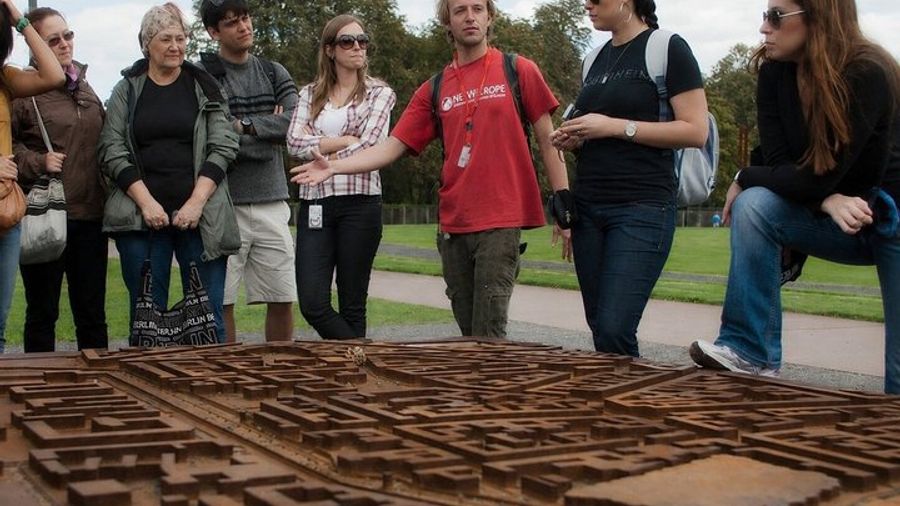
- ✓We reach the Berlin Wall Memorial on Bernauer Straße, the most complete surviving stretch of the border and the place where its full horror is laid bare. Your guide walks you through the anatomy of the Wall, built almost overnight on 13 August 1961: not a single barrier but a deadly system of outer wall, floodlit Death Strip, patrol roads, signal fences, watchtowers and inner wall, engineered to trap an entire population. Bernauer Straße saw some of the most dramatic scenes of all — residents leaping from upper windows as their homes were bricked up beneath them, and the daring escape of Tunnel 57. Here your guide remembers the victims, among them Peter Fechter, left to die in the Death Strip within sight of both sides. It was, they explain, one of the most sophisticated border systems ever built — designed to stop a country's own people from leaving.
- ✓Our walk ends at the Chapel of Reconciliation, a quiet, curved building of rammed earth that stands as a gentle epilogue to a hard story. Your guide tells its remarkable history. The original church once stood marooned in the Death Strip, cut off from its congregation and finally blown up by the GDR in 1985 as an obstacle to the border. After reunification, a new chapel rose on the same ground — a symbol of healing where there had been only division. From here your guide draws the whole story together: the Peaceful Revolution of 1989, the Monday demonstrations, and the night the Wall finally opened, leading to German reunification. East Berlin's story, they explain, is not one of concrete alone, but of ordinary people shaped by surveillance and courage — and of one of history's greatest examples of peaceful change.
What's included
- ✓Professional guide
- ✓Public transportation ticket (zone AB) short trip. If you have a day ticket already, you're all set.
- ✓Small-group experience
What's not included
- ✓Hotel pickup and drop off
- ✓Food and drinks
- ✓Gratuities
Good to know
Wheelchair accessible
Infants and small children can ride in a pram or stroller
Public transportation options are available nearby
Transportation options are wheelchair accessible
All areas and surfaces are wheelchair accessible
Travelers should have at least a moderate level of physical fitness
Children under the age of 13 may join free, however, please note that some content may not be suitable for younger guests.
Our guides have your best interests in mind; while the tour usually includes the sites & stories mentioned and lasts about 2-2.5 hours, your tour may vary depending on what your guide thinks is best for your group.
A moderate amount of walking is involved, comfortable shoes are recommended.
Cancellation policy
- •A full refund will apply if you cancel more than 24 hours before the activity start time.
- •No refund is possible if you cancel less than 24 hours before the activity start time.

Berlin Communism and Berlin Wall Walking Tour
Meet your guide in the afternoon at Berlin’s Brandenburg Gate. Proceed with your guide into the former East German sector of Berlin, learning about daily life and key events during this critical Cold War period. Follow the path of the iconic Berlin Wall which once split the now-reunited German capital in half, learning about the people, places, and secrets that fueled the battle between East and West during the period following World War II. Over the course of your visit, get a look at key East Berlin sites from the Soviet period including the one-time embassies of the major Cold War powers, key Berlin Wall crossing spots such as the “Palace of Tears" that once separated the two divided cities. As you explore, your guide also shares stories about the key events and moments of Cold War Berlin. Learn about the Stasi, East Germany’s secret police, hear about dramatic escape stories, and discover the meaning behind the concept of “ostalgie” in modern-day Berlin. For a more detailed run-down of key trip highlights, please review the itinerary details below.
Highlights
- ✓Learn about East Berlin form an English-speaking guide
- ✓Get your steps in with a walking tour
- ✓Hear about daring escape attempts from East Berlin and the notorious Stasi secret police
- ✓A great introduction to the Cold War history of Berlin
What you'll see & do
- ✓Meet your guide at the Brandenburg Gate, the neoclassical landmark that became the defining symbol of a divided — and finally reunited — Berlin. There is no better place to begin the story of the Cold War city. Your guide sets the scene at the end of the Second World War, when a defeated Germany was carved into four Allied occupation zones. Berlin, though it lay deep inside the Soviet zone, was itself split four ways — and in 1949 the country divided into the communist GDR in the east and the democratic FRG in the west, with this city on the frontline between them. For nearly three decades the Gate stood marooned in the Death Strip, unreachable behind the Wall. Your guide introduces the walk ahead: a journey through espionage, surveillance, divided families and the courage that finally brought the Wall down.
- ✓We stop before the grand Russian Embassy on Unter den Linden, a vast and imposing building that speaks of Moscow's power at the very heart of the city. Your guide uses it to tell the story of Soviet control. After the Red Army took Berlin in 1945, Soviet occupation policy reshaped the east, and in 1949 the German Democratic Republic was born, governed by the all-powerful Socialist Unity Party (SED). Yet real authority lay in Moscow — as became brutally clear in June 1953, when Soviet tanks crushed a workers' uprising in the streets of East Berlin. Your guide explains how the Brezhnev Doctrine later formalised Moscow's grip over the entire Eastern Bloc. On paper the GDR was a sovereign state, but politically, economically and militarily it remained bound to the Soviet Union — a satellite that could never truly stand alone.
- ✓A short walk brings us to the site of the former American presence near the Gate, where your guide turns to one of the Cold War's most shadowy dimensions: Berlin as the espionage capital of the world. Here, East and West stood only metres apart, and the city became the great chessboard of the intelligence war — CIA against KGB, with British and French services woven in. Your guide reveals the tradecraft of the era: Operation Gold, the audacious tunnel dug to tap Soviet phone lines; the double agents and defectors who slipped between sides; the hidden cameras, coded messages and even assassination attempts. Most dramatic were the spy exchanges at the Glienicke Bridge, where captured agents were swapped in the dead of night. Your guide brings this secret world to life — proof that the Cold War was fought as much through cunning as through force of arms.
- ✓We arrive at the Tränenpalast, the "Palace of Tears," a glass and steel pavilion that once served as the border crossing between East and West Berlin at Friedrichstraße station. Your guide explains the heartbreak that gave the building its name. This was where East Berliners said goodbye to visiting relatives from the West, enduring strict passport controls, customs searches and interrogations. Ordinary Westerners could visit; East Germans were rarely allowed to travel freely at all, and the farewells here were often agonising. Your guide tells the human stories: families split overnight when the border closed in August 1961, tearful separations at this very threshold, and the daily reality of life divided by the Iron Curtain. The Wall, they explain, cut through not just a city, but through families, friendships and everyday life.
- ✓We descend into Nordbahnhof, once one of Berlin's eerie "ghost stations" — the Geisterbahnhöfe that haunted the divided city's underground. Your guide explains the strange geography of a split transport network. When the Wall went up on 13 August 1961, stations like this one, though physically in the East, sat on lines used by West Berlin trains. The solution was chilling: West Berlin trains rumbled slowly through without stopping, past dimly lit, sealed platforms patrolled by armed border guards, while the entrances above were bricked shut to keep Easterners out. Through original photographs and maps, your guide shares the stories of commuters whose city was severed overnight, and the desperate escapes attempted through the rail infrastructure. Even Berlin's underground became part of the border — ordinary stations turned into silent monuments to division.
- ✓We reach the Berlin Wall Memorial on Bernauer Straße, the most complete surviving stretch of the border and the place where its full horror is laid bare. Your guide walks you through the anatomy of the Wall, built almost overnight on 13 August 1961: not a single barrier but a deadly system of outer wall, floodlit Death Strip, patrol roads, signal fences, watchtowers and inner wall, engineered to trap an entire population. Bernauer Straße saw some of the most dramatic scenes of all — residents leaping from upper windows as their homes were bricked up beneath them, and the daring escape of Tunnel 57. Here your guide remembers the victims, among them Peter Fechter, left to die in the Death Strip within sight of both sides. It was, they explain, one of the most sophisticated border systems ever built — designed to stop a country's own people from leaving.
- ✓Our walk ends at the Chapel of Reconciliation, a quiet, curved building of rammed earth that stands as a gentle epilogue to a hard story. Your guide tells its remarkable history. The original church once stood marooned in the Death Strip, cut off from its congregation and finally blown up by the GDR in 1985 as an obstacle to the border. After reunification, a new chapel rose on the same ground — a symbol of healing where there had been only division. From here your guide draws the whole story together: the Peaceful Revolution of 1989, the Monday demonstrations, and the night the Wall finally opened, leading to German reunification. East Berlin's story, they explain, is not one of concrete alone, but of ordinary people shaped by surveillance and courage — and of one of history's greatest examples of peaceful change.
What's included
- ✓Professional guide
- ✓Public transportation ticket (zone AB) short trip. If you have a day ticket already, you're all set.
- ✓Small-group experience
What's not included
- ✓Hotel pickup and drop off
- ✓Food and drinks
- ✓Gratuities
Good to know
Wheelchair accessible
Infants and small children can ride in a pram or stroller
Public transportation options are available nearby
Transportation options are wheelchair accessible
All areas and surfaces are wheelchair accessible
Travelers should have at least a moderate level of physical fitness
Children under the age of 13 may join free, however, please note that some content may not be suitable for younger guests.
Our guides have your best interests in mind; while the tour usually includes the sites & stories mentioned and lasts about 2-2.5 hours, your tour may vary depending on what your guide thinks is best for your group.
A moderate amount of walking is involved, comfortable shoes are recommended.
Cancellation policy
- •A full refund will apply if you cancel more than 24 hours before the activity start time.
- •No refund is possible if you cancel less than 24 hours before the activity start time.